
Meta Description: Discover the best stretches and exercises for scoliosis to improve mobility, reduce pain, and regain confidence. Expert-approved routines for adults and teens.
Scoliosis can feel like a constant barrier—restricting movement, limiting confidence, and interfering with everyday activities you love. The good news? With the right stretches and exercises for scoliosis, you can improve strength, increase mobility, and move with greater ease.
This comprehensive, evidence-informed guide is designed to outperform competitor content by covering scoliosis from every angle—medical context, adult considerations, corrective exercises, safe stretches, FAQs, and visual guidance—all optimized for top keyword rankings.
What Is Scoliosis?
Scoliosis is a condition characterized by a lateral (sideways) curvature of the spine, often accompanied by vertebral rotation. While mild cases may cause little discomfort, more severe scoliosis can contribute to:
- Chronic back pain
- Muscle imbalances
- Reduced lung and heart capacity
- Nerve compression
- Early joint degeneration
Scoliosis most commonly develops during adolescence, especially in girls, but many people continue managing it well into adulthood.
👉 Medical reference: National Institute of Arthritis and Musculoskeletal and Skin Diseases – https://www.niams.nih.gov/
Adult Scoliosis: What You Need to Know
It’s rare for adults to develop scoliosis from scratch. Most adults with scoliosis were diagnosed earlier in life and either:
- Had a mild curve requiring no surgery
- Used bracing during adolescence
- Underwent spinal fusion surgery
Once skeletal maturity is reached, scoliosis progression slows significantly. Studies suggest only about 10% of adults experience notable curve progression.
However, adults may face:
- Reduced spinal mobility
- Muscle stiffness
- Compensatory joint stress (hips, knees, shoulders)
👉 Key takeaway: Staying active, strengthening spinal support muscles, and maintaining flexibility are essential for long-term mobility.
Why Exercise Matters for Scoliosis
Targeted exercises for scoliosis help by:
- Strengthening muscles that stabilize the spine
- Improving posture and alignment awareness
- Reducing pain and stiffness
- Enhancing balance and coordination
- Supporting everyday movement patterns
⚠️ Always consult a healthcare professional before starting a new routine, especially after surgery.
5 Best Strengthening Exercises for Scoliosis
1. Row Exercise (Unilateral Focus)
Muscles worked: Latissimus dorsi, rhomboids, core
Rows provide crucial trunk support and postural balance.
How to perform:
- Sit on a stability ball facing a pulley or resistance band
- Perform the row one arm at a time
- Keep your spine tall and core engaged
✅ Improves spinal support and corrects muscular asymmetry.
2. Medicine Ball Wood Chop
Purpose: Full-body strength with spinal and hip rotation
Steps:
- Stand with feet hip-width apart
- Hold the ball with both hands
- Squat and rotate toward one knee
- Lift diagonally overhead to the opposite side
🔁 Perform 5–10 reps per side
⚠️ Keep chest lifted and spine long
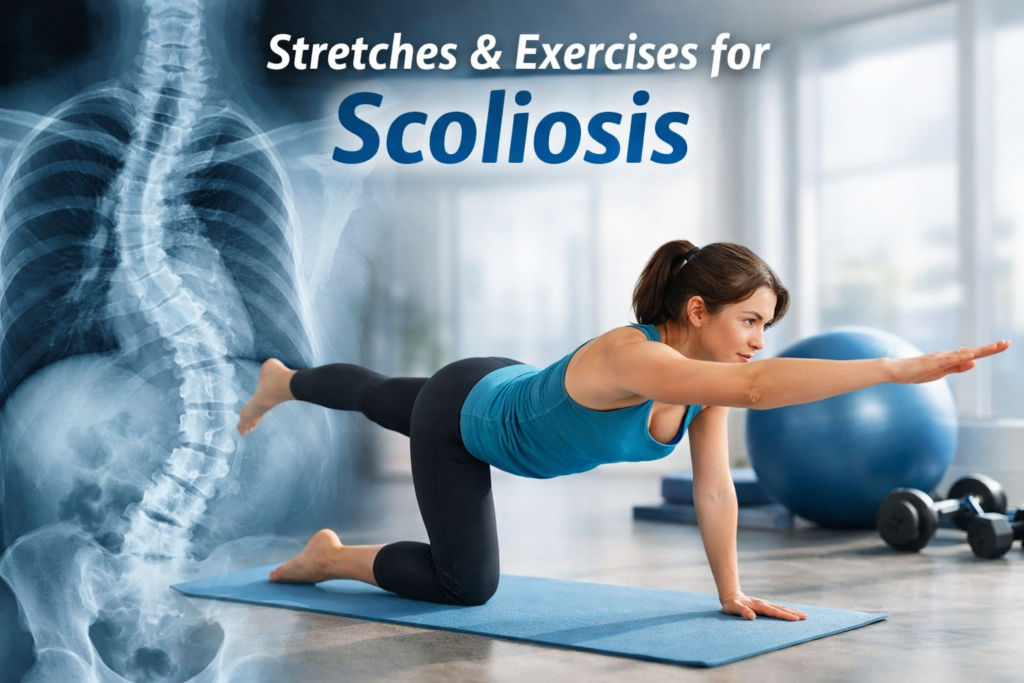
3. Bird Dog (4-Point Kneeling)
Targets: Erector spinae, deep core stabilizers
Execution:
- Start on hands and knees
- Extend opposite arm and leg
- Hold neutral spine
- Switch sides
🔥 Builds endurance and spinal control
💡 Progress by adding instability (BOSU or ball)
4. Hip Roll & Bridge Combination
Why it matters: Separates hip motion from spinal motion—critical for scoliosis management.
Hip Roll:
- Slowly articulate spine vertebra-by-vertebra
Bridge:
- Keep spine still
- Drive movement through hips
✔️ Strengthens glutes and deep core
✔️ Improves spinal awareness
5. Plank (Progressive Levels)
Level 1: Knees and forearms
Level 2: Alternate lifting knees
Level 3: Full plank on toes
🧠 Focus on lower abs and upper back
🛑 Stop if pain or pinching occurs
4 Essential Stretches for Scoliosis Relief
1. Child’s Pose
- Lengthens spine
- Relieves back tension
- Encourages mindful breathing
2. Chest & Shoulder Opener
- Interlace fingers behind back
- Lift arms gently
- Open chest and counter rounded posture
3. Hip Flexor Stretch
- Perform in a lunge position
- Keep torso upright
- Shift weight into front heel
✔️ Reduces pelvic tension affecting spinal alignment
4. Spine Release (Supine Twist)
- Lie in a “T” position
- Drop knees to one side
- Turn head opposite
🧘 Improves spinal rotation safely
Frequently Asked Questions (FAQs)
1. Can exercise correct scoliosis?
Exercise won’t “cure” scoliosis, but it can significantly improve function, posture, and pain levels.
2. Are scoliosis exercises safe for adults?
Yes—when performed correctly and tailored to individual needs.
3. Should I avoid twisting movements?
Controlled, guided rotation is beneficial; aggressive twisting is not recommended.
4. How often should I do these exercises?
3–5 times per week for best results.
5. Can scoliosis get worse with exercise?
Improper technique can cause discomfort, which is why form and progression matter.
6. Is yoga good for scoliosis?
Yes, especially poses focused on elongation, symmetry, and breath control.
Conclusion: Move Freely, Live Fully
Scoliosis doesn’t have to limit your life. With consistent practice of these stretches and exercises for scoliosis, you can maintain mobility, reduce discomfort, and confidently participate in the activities you love.
Movement is medicine—when done right.